Cigarette factories in Indonesia need ERP for cigarette factories, which is a system that connects raw materials, production, quality, machines, and tax stamps. Without it, tobacco shrinkage, tax stamp discrepancies, and costs per new batch are only visible at the end of the month.
This article discusses the cigarette manufacturing process in general, the system needs that commonly arise in cigarette factories, the Odoo 20 applications used, the process flow, and Odoo solutions for each need. The examples in this article are general and do not refer to any specific company.
Cigarette Manufacturing Process
In general, machine-made cigarettes (both clove machine cigarettes and white machine cigarettes) are produced in two major stages: primary (processing tobacco and cloves) and secondary (making cigarette sticks and then packaging them).
- Receiving raw materials. Tobacco and cloves come from farmers or suppliers, then checked for grade, origin, harvest year, and moisture content. Supporting materials such as cigarette paper, filters, aluminum foil, labels, cartons, and tax stamps are also received in the warehouse.
- Storage and aging. Tobacco is stored for a while to allow its aroma to mature before processing.
- Primary: blending and cutting. Some grades of tobacco are mixed according to brand recipes, cut, given sauce or casing, and then dried to a certain moisture content. Clove is cut separately and then mixed.
- Secondary: making. The maker machine wraps the tobacco mixture in cigarette paper and attaches a filter, producing cigarette sticks.
- Secondary: packing. The packer machine inserts the sticks into packaging, attaches tax stamps, and then packs them into slop and cartons.
- Quality control. Inspections are conducted at every stage: moisture content, stick weight, draw resistance, filter ventilation, and packaging appearance.
- Finished goods warehouse and distribution. Cartons are stored by batch and then sent to distributors.
ERP Needs for Cigarette Factories
From the above process, there are eight needs that frequently arise when cigarette factories seek ERP systems:
- Raw material traceability. Each batch of cigarettes must be traceable to the grade, origin, and harvest year of the tobacco and cloves.
- Controlled blend recipes. Blend recipes per brand must have versions, and recipe changes require approval.
- Shrinkage and yield control. Tobacco loses weight during processing and drying; the difference between standard and actual must be visible per batch.
- Tax stamp control. Tax stamps are of high value and monitored by Customs, so stock, usage, and damaged ones must be recorded by series and rate.
- Periodic QC on the production floor. Weight, pull and moisture checks are routinely performed per machine and per shift.
- Utilization of maker and packer machines. Downtime and its causes must be recorded so that capacity can be maximized.
- Machine maintenance. High-speed machines need scheduled maintenance to avoid sudden stops.
- Accurate HPP per batch. Material, labor, and overhead costs must be included in the production cost without re-input.
Modules of Odoo 20 Used
All the following applications run on a single Odoo 20 database, so data from warehouse, production, QC, and finance are interconnected.
Category | Application | Role in the cigarette factory |
|---|---|---|
Supply Chain | Purchase | Purchasing tobacco, cloves, and packaging materials from suppliers |
Supply Chain | Inventory | Stock per warehouse and location, lot number per tobacco grade, excise stamp stock |
Supply Chain | Barcode | Receiving, transfer, and stocktaking with scan |
Supply Chain | Manufacturing | Recipes (BoM) with primary and secondary levels, production orders, machine work centers, Shop Floor |
Supply Chain | Product Lifecycle Management (PLM) | Blend recipe versions and change approvals (ECO) |
Supply Chain | Quality | Inspection points per operation, QC arrival, quality alert |
Supply Chain | Maintenance | Scheduled maintenance and repairs of maker and packer machines |
Finance | Accounting | Inventory valuation (AVCO, FIFO or standard price), COGS, financial statements |
Human Resources | Employees, Attendances | Operator data per shift and attendance |
Several updates of Odoo 20 are relevant for cigarette factories, including continuous production (the next operation can start when some results are ready), one button Produce, Kanban view and planning per employee for work orders, as well as the option for production orders to be created as drafts before confirmation (source).
Process Flow Diagram in Odoo
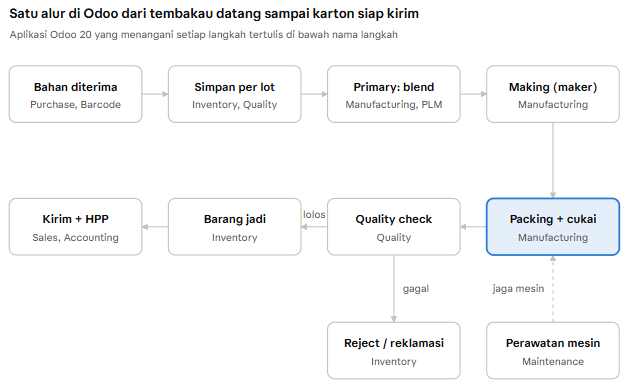
Raw materials with lot numbers, processed in primary, made into sticks in maker, then packaged with tax stamps. Results that pass QC enter the finished goods warehouse; rejects are recorded separately, and machines are maintained through Maintenance.
Understanding BoM, Machines & Operators, and Quality Control in Odoo
These three concepts are the foundation of the Manufacturing module in Odoo. Understanding them helps the production team read how the system works.
Bill of Materials (BoM): product recipe
BoM is a recipe that specifies what materials and how much is needed to make one product. In cigarette factories, BoM is usually created hierarchically according to production stages:
Level | Production output | Components | Operations & machines |
|---|---|---|---|
1. Primary | Processed tobacco (kg) | Tobacco of several grades, shredded cloves, sauce/casing | Blending, cutting, drying in the primary line |
2. Making | Cigarette sticks (per 1,000 sticks) | Processed tobacco, cigarette paper, filters, tipping paper | Making on the maker machine |
3. Packing | Wrap, slop and carton | Cigarette sticks, wrap, aluminum foil, tax tape, slop, carton | Packing on the packer machine |
Some important BoM settings for the cigarette factory:
- Operations (routing): each BoM contains work steps, machines used, and standard times, so that schedules and machine costs are calculated automatically.
- By-product: tobacco waste, reject sticks or reclaimed tobacco are recorded as by-products, not just lost.
- Consumption (material usage): can be set to allow usage outside the recipe, give warnings, or be blocked. This is how Odoo controls shrinkage.
- Recipe version: with the PLM application, each blend change is saved as a new version and must be approved before being used in production.
If Material Usage Exceeds or Falls Short of BoM
In the field, actual usage almost never matches the recipe exactly. Tobacco can shrink more due to moisture content, paper can be wasted during machine setup, or production results can be less than planned. Odoo records usage actual, not just recipe numbers, so every difference has a visible impact.
Area | If materials used are MORE than BoM | If materials used are LESS than BoM |
|---|---|---|
Material stock | Stock of materials decreases faster; next purchase needs increase | Remaining materials are still recorded in the warehouse and can be used for the next batch |
Cost per batch | Material cost per unit increases, cost is higher than standard | Material cost per unit decreases, cost is lower than standard |
Value of finished goods inventory | Finished goods are valued higher (AVCO/FIFO method) | Finished goods are valued lower (AVCO/FIFO method) |
Profit | Margin per package decreases if the selling price remains | Margin increases, but it needs to be checked whether the quality remains up to standard |
Tax stamp | Used stamps exceeding the number of packages indicate that the stamps are damaged or lost; must be explained during reconciliation with Customs | Remaining stamps must be returned to the stamp storage location to match the balance |
Quality | May indicate machine settings are problematic or materials are below standard | May indicate the rod is too light; needs to be matched with the QC results of rod weight |
How Odoo controls and reports discrepancies:
- Consumption settings in BoM: Allowed (free), Allowed with warning (supervisor is warned when usage differs from the recipe) or Blocked (production cannot be closed if usage differs). For tobacco with normal shrinkage, usually used warning; for tax stamps safer blocked.
- Production results more or less than planned: if the output is less, Odoo offers backorder for the remaining quantity that has not been produced; if more, the actual recorded output and materials adjust.
- Variance report: each production order has a cost analysis comparing standard costs with actual. Material usage per batch can also be viewed in the stock movement analysis (Moves Analysis) and exported to a spreadsheet.
- Standard pricing method: if the product uses standard pricing, the value of finished goods remains according to standard and the variance is recorded to the variance account according to accounting configuration, allowing management to see the total production variance for each period.
- Recipe improvement: if variances occur continuously, the recipe is updated through PLM (ECO) to ensure standards match actual conditions.
In essence, the BoM variance is not just a stock figure: the variance directly affects COGS, inventory value, profit, and accountability for excise duties. Therefore, the variance report per batch should be routinely reviewed by PPIC, QC, and the finance department.
Machine (Work Center) and Operator (Worker)
Work center is a representation of machines or production lines in Odoo, such as primary line, machine maker 1–4, and machine packer 1–4. Each work center has:
- Working hours according to factory shifts, so production schedules only fall within operational hours.
- Capacity and setup/cleaning time, used when calculating production duration.
- Cost per hour, which goes into COGS for each batch.
- Alternative machines, so work can be transferred to another machine if one machine is broken or full.
- Target OEE, to compare the effectiveness of actual machines with the target.
Each production order is broken down into work order per operation per machine. This is where operator (worker) plays a role:
- Operators log into the tablet Shop Floor on the machine with their respective employee PIN. Operators press start, pause, and finish; working time is recorded per operator and per shift.
- The operator presses start, pause, and finish; working time is recorded per operator and per shift.
- When the machine stops, the operator selects downtime reason (e.g., setup, materials run out, breakdown); this data forms the OEE report.
- Operator working time is calculated as labor cost in HPP.
- Odoo 20 adds a view of planning per employee to see the workload of each operator.
Quality Control
Quality control in Odoo is managed through Quality Control Point, which are rules on when and what to check. Checkpoints can be set at material reception, specific production operations, or shipping.
QC Points | Types of inspections in Odoo | Examples in a cigarette factory |
|---|---|---|
Tobacco & clove reception | Measure (value with tolerance limits) | Moisture content, grade |
Primary | Measure | Moisture content after drying |
Making | Measure, Pass-Fail | Weight of the stick, draw resistance, filter ventilation |
Packing | Pass-Fail, Take a Picture | Neatness of packaging, position of the excise tape |
Finished goods warehouse | Pass-Fail | Condition of carton and batch label |
How it works:
- Frequency inspections can be set for every production run, random based on percentage, or periodic (daily or weekly). Inspections with specific hour intervals, for example every 30 minutes, can be added through adjustments.
- Results Measure outside the tolerance limits are automatically marked as failed.
- Failed results can generate a Quality Alert for follow-up by the QC team, and products are moved to quarantine or reject locations.
- All inspection results are stored per batch and per lot, so quality history can be traced at any time.
Odoo Solutions for Every Need
Needs | Solutions in Odoo 20 | Application |
|---|---|---|
Raw material traceability | Each receipt of tobacco and cloves is assigned a lot number containing grade, origin, and harvest year. The traceability report traces cigarette batches back to their material lots, and vice versa. | Inventory, Barcode |
Controlled blend recipe | Tiered BoM: blend recipe (primary) becomes components of the cigarette stick BoM and packaging BoM (secondary). Recipe changes through ECO with versioning and approval. | Manufacturing, PLM |
Shrinkage and yield | Actual usage is recorded in the production order; the difference against the BoM is visible per batch. Residuals and rejects are recorded as by-products, such as reclaimed tobacco. | Manufacturing, Inventory |
Tax stamp | Tax stamps are managed as products with serial numbers or lots per tariff, stored in a special location, and automatically cut as packing BoM components. Damaged stamps are moved to a separate location so that their balance can be easily reconciled. The report format to Customs is prepared as an additional report. | Inventory, Manufacturing |
Periodic QC | Quality control points per operation (making, packing) for weight, pull, moisture content, and visual; failed results trigger a quality alert. QC at specific time intervals can be added through adjustments. | Quality |
Machine utilization | Maker and packer machines as work centers with shift schedules. Operators start, pause, and finish from the Shop Floor; reasons for downtime and machine effectiveness (OEE) are recorded. | Manufacturing |
Machine maintenance | Scheduled preventive maintenance per machine; operators report damages from the Shop Floor; repair history is stored per machine. | Maintenance |
Cost per batch | Materials, machine hours, and labor are calculated into production costs; inventory valuation and COGS journals are formed automatically. | Accounting, Manufacturing |
Closing
With Odoo 20, the cigarette factory can manage tobacco, blend recipes, machines, quality, tax stamps, and COGS in one system. Management no longer needs to wait for the end-of-month recap to know material shrinkage, tax stamp discrepancies, or costs per batch.
Implementation usually starts from production and warehouse, then continues to finance, sales, and HR gradually. The initial step is to map the current processes and determine which needs can be met with Odoo's standard features and which require adjustments.
Want to implement Odoo in your factory? Consult your production needs with the InfinysCloud team, Odoo's official partner:
- Phone: 021-2968-2828
- Email: sales@isi.co.id
- Website: integra.infinyscloud.com/contactus